St Barbara's Mining Trail

A scenic walk through the mining heritage of Černý Důl and the natural beauty of the surrounding countryside.
Key information
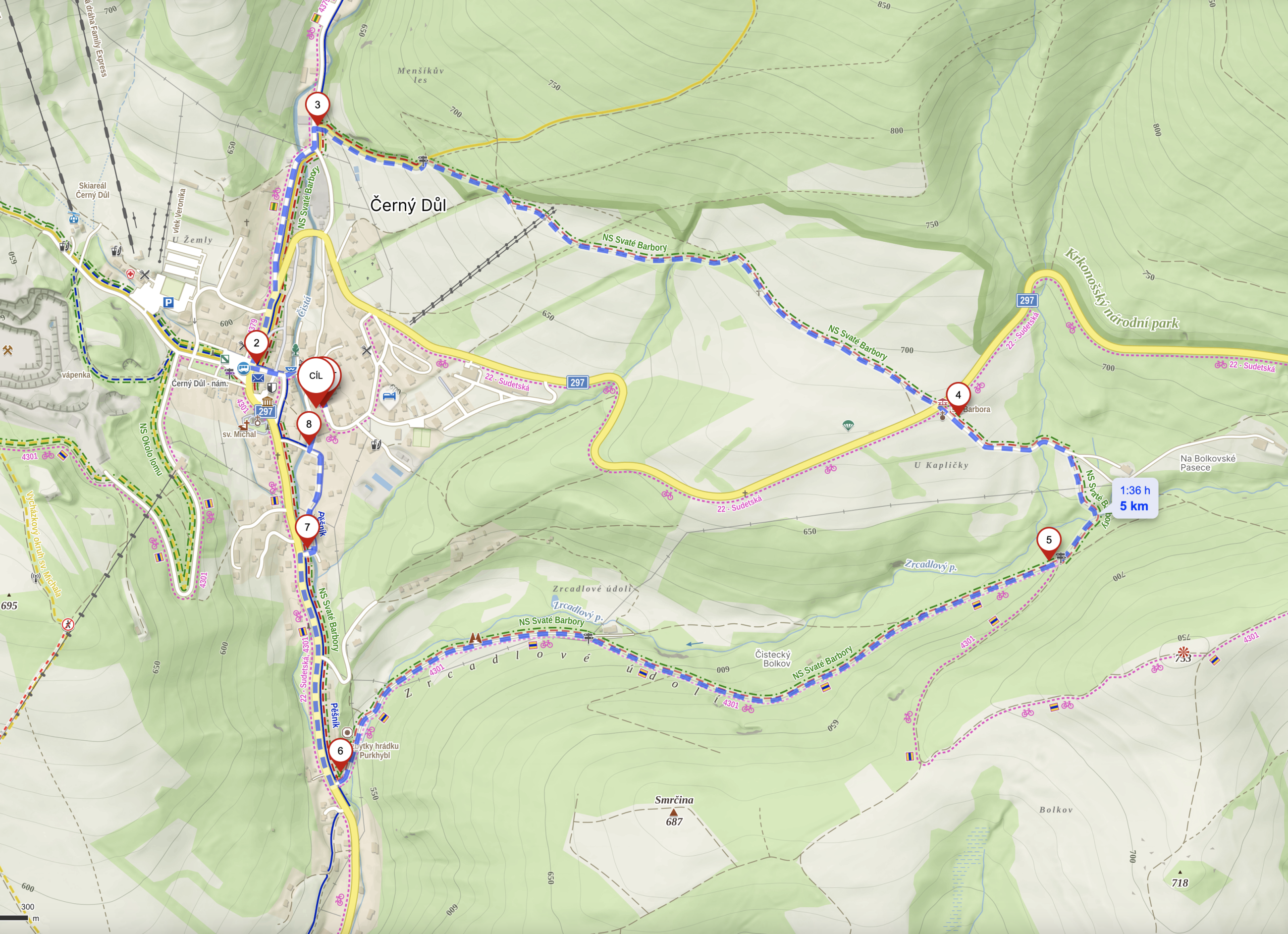
Distance: 5 km
Duration: approx. 1.5 hours
Difficulty: Moderate
All-terrain pushchair: No
Route description
The walk starts in the square in Černý Důl, where you join the circular St Barbara’s Trail. This is a pleasant mountain path, with an overall elevation gain of around 188 metres.
The trail climbs gradually to its highest point on the slopes of Černá hora, where beautiful views open out across the surrounding countryside. It then descends more steeply back into the valley.
Along the way, you’ll pass St Barbara’s Chapel, walk through Mirror Valley and Menšík Forest, and come across the ruins of Purkhýbl Castle. The route is marked with local red-and-white trail markers and follows a cycle route in places.

Zlaťák’s tip
Try to find all six Schwarzenthal Poudačky story stops along the trail.
These mysterious, slightly spooky stories were created for the route by Radek Etrych and draw on the rich history and folk tales of the Krkonoše Mountains.
They recall the past of Černý Důl, where metal ores and later uranium were mined, and bring back the atmosphere of a landscape once full of miners’ legends.
The trail is named after St Barbara, the patron saint of miners, whose story is closely linked with the history of Černý Důl.
Along the way, you’ll also find a wooden xylophone carved from a tree trunk. It may look simple, but it produces surprisingly powerful sounds.
Near the start of the walk, you’ll pass the Mileta factory, one of the last working textile factories in the Krkonoše Mountains. It specialises in handkerchiefs and fine shirting fabrics. The factory was founded in 1874 by Josef Menčík, who was just twenty-seven at the time. He built it on the site of a former mill as a mechanical weaving mill and dye works. Josef Jan Menčík (1847-1920) was probably the most important entrepreneur in the history of Černý Důl. He later owned spinning mills, weaving mills and dye works in Vrchlabí, Dolní Branná and Líšný.